
WordPress performance for businesses where speed is revenue.
Core Web Vitals, server response, database, page assets, plugin architecture – we find the real causes of slow performance and fix them at the source.
A cache plugin alone won’t solve a problem that lives deeper in the architecture. We measure first, identify what’s actually slowing the site, and fix what truly affects performance. Every change verified with concrete numbers, not estimates.
WHAT WE OPTIMIZE
Five areas. One outcome: a measurably faster site.
WordPress performance work that goes beyond plugin defaults. Experienced engineers identify the real bottlenecks, not just the obvious symptoms.
01
Core Web Vitals (LCP, INP, CLS)
Three metrics Google uses to evaluate user experience, and what visitors actually feel. LCP (how fast the main content loads), INP (how quickly the page responds to clicks), CLS (how stable the layout stays as it loads).
The result: faster pages, better Google rankings, higher conversion – measured against your actual baseline, not industry averages.
02
Server response and infrastructure
We check how long the server takes to respond to a page request, how the hosting is configured, and whether content is delivered from a location close to the user (CDN). The server is often where the wait starts, and no amount of front-end optimization fixes a slow backend.
The result: shorter perceived load times, better stability when traffic spikes.
03
Database query optimization
Slow queries running on every page load, missing indexes, repeated lookups hidden behind a clean front-end. The database is often the bottleneck nobody looks at.
The result: pages that don’t slow down as your content grows or your customer count scales.
04
Page asset optimization
Images sized to what users actually see, in modern formats. Scripts and styles loaded in a way that doesn’t block content from appearing. Fonts delivered without delay. The browser-side work that determines what users actually feel.
The result: faster first paint, less wasted bandwidth, better mobile experience.
05
Plugin architecture and custom code
Plugin sprawl is one of the biggest hidden performance costs in WordPress. Each plugin adds queries, JavaScript, and components of its own. We replace heavy plugins with focused custom code where it matters – and tell you which plugins to keep, which to swap, and which to remove.
The result: less code running on every page load, fewer conflicts, easier maintenance.

Need a formal performance audit report?
A WordPress performance audit (one-off measurement and assessment with documented findings, suitable for SEO team or board reporting) is part of WordPress audits →.
WHO NEEDS THIS
Familiar situations we know how to handle.

Core Web Vitals affecting rankings or conversion
Google’s Core Web Vitals are a ranking signal. They’re also what users feel. When these metrics fall below the recommended thresholds, the impact is dual: lower SEO visibility and lower conversion from the visitors who do land. Cache plugins and image optimizers handle the easy cases. Architectural causes need a different kind of work.
We identify what’s actually slowing the page at the architecture level and fix it at the source.

Site struggles under traffic spikes
Campaigns, sales events, seasonal peaks, viral moments. The site that runs fine on a normal Tuesday fails on Black Friday. Plugin-based solutions hit limits. Caching only goes so far when the database is the bottleneck.
We optimize for stability under load, not just average speed, so the system holds when traffic actually matters for the business.

Quick fixes haven’t delivered
You’ve installed the cache plugin. You’ve optimized the images. The PageSpeed Insights score is unchanged. The problem is usually in how the system was built, and it surfaces only under real traffic.
We diagnose, isolate the real bottlenecks, and prioritize fixes by measured impact, not by what’s easy to change.
METHODOLOGY
How a performance project runs.
STEP 01
Baseline measurement
We measure the current state with real tools, not just PageSpeed Insights. Data from your actual visitors, synthetic tests in controlled conditions, server-side profiling, database query analysis. The baseline becomes the reference point for everything that follows.
STEP 02
Bottleneck identification
We profile what’s actually slowing the page. Database queries, plugin overhead, asset blocking, server-side time. Each bottleneck quantified by its measured impact on the metrics that matter to your business.
STEP 03
Prioritized implementation
We fix what moves the needle. Highest-impact, lowest-risk first. Each change documented, each change reversible. We focus only on the elements that actually need to change.
STEP 04
Measured verification
Before-and-after numbers for every change. Real measurements, not estimates. If a change doesn’t deliver the expected effect, we revert it.
STEP 05
Documentation and handoff
Written record of what was changed, what was measured, what to monitor going forward. Your team can extend the work or hand it back to us. The dashboard stays with you.
WHAT YOU GET
Concrete deliverables tied to measured numbers.
The state captured before any changes: LCP, INP, CLS, server response time, page weight, query counts. The numbers your SEO team and your board can use as a starting point.
The same metrics measured after the work, side-by-side with the baseline. A clear picture of what was achieved on each optimized layer.
Configured monitoring that tracks the metrics over time and shows what’s happening with real users in production.
What to watch for as the site grows. Where the next bottleneck will appear. Which plugins to avoid. Practical guidance for the team that lives with the system after our engagement ends.
Continued monitoring, monthly review, performance regression catches. Available as a standalone retainer or as part of Growth & Care.
After the project
Continued performance work as part of Growth & Care, or formal documentation via WordPress audits when you need a board-level report or SEO team documentation.
CASE STUDIES
WordPress in practice.

LernerPython
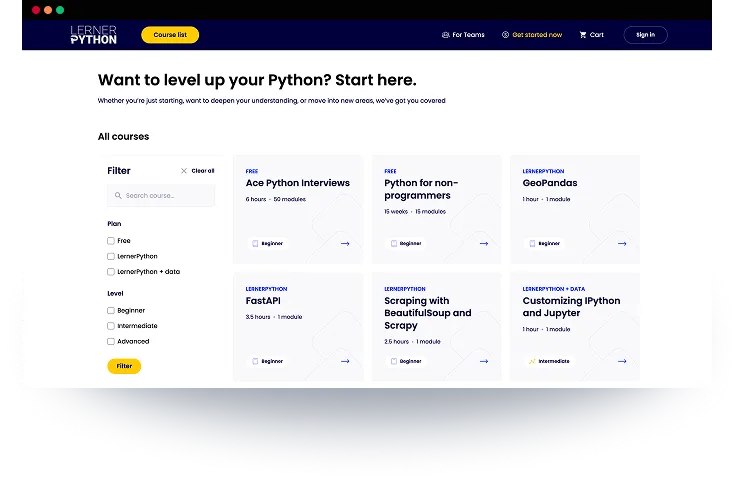
LernerPython is a premium, membership-based e-learning platform created by Reuven Lerner, an internationally recognized teacher and author of books on the Python programming language. The platform offers: structured Python courses, weekly coding challenges, access to a community via Discord, and long-term memberships for programmers at various skill levels.

Enostrada

A lifestyle media project created by three enthusiasts: Robert (wine expert), Wojtek (culinary creator) and Kamil (travel & experiences). Their vision: a single modern platform combining wine, food, travel, and events, supported by high-quality articles, reviews, pairings and guides.

SCCG

SCCG Management is a leading consulting firm serving the global gaming industry, working with operators, suppliers, regulators and investors across multiple jurisdictions.
Questions about WordPress performance.
Plugins and tools handle the easy cases. They don’t address architectural causes: slow database queries, plugin sprawl, server-side bottlenecks. We use those tools too, but the real work is what they can’t do: identify the root causes that compound under real load.
Faster hosting helps, but only with infrastructure-bound problems. If the database has a slow query running on every page load, no hosting will fix it. We start with measurement to figure out which layer the problem is on, and recommend a hosting upgrade only if it’s actually the constraint.
No. Once the project ends, the site is optimized, documentation handed over, monitoring dashboard configured. Your team can extend the work on its own. If long-term partnership makes sense (through Growth & Care or a separate retainer), we offer that option, but it’s not a precondition.
No. We work with whatever hosting you have. If a hosting migration is the right call (sometimes it is), we’ll say so with the reasoning, but it’s not a precondition.
The ones that give the fullest picture: data from your actual visitors, synthetic tests in controlled conditions, server log analysis, database query inspection. PageSpeed Insights and Google Search Console too, but we treat them as one of several sources, not the only one. The exact toolset is matched to the situation and the client’s existing infrastructure.