
Enterprise WordPress for B2B eCommerce.
Account-based pricing, ERP integration, multi-step order workflows, and the B2B business logic that standard platforms do not handle without compromise.
B2B commerce differs from B2C in more than the size of the invoice. Customer-specific catalogs, negotiated pricing, credit limits, approval chains, and integration with the systems supporting procurement, finance, and fulfillment — none of it is addressed by stock configurations. We build B2B eCommerce platforms on WooCommerce for manufacturers, distributors, and wholesale businesses that have moved beyond templated solutions and licensing-heavy proprietary platforms.
WHAT CHANGES
Five areas where the platform stops constraining the commercial model – and begins supporting it.
Find out how B2B Platform can support your company’s growth rather than hinder it.
01
Account-based pricing and negotiated catalogs
Pricing tiers per customer or account, contract-specific catalogs, hidden products for non-qualified buyers, currency per customer, and unit-of-measure rules. The pricing engine is part of the platform architecture, not a plugin added onto the system.
The result: the commercial team negotiates the contracts the business genuinely closes, instead of forcing each contract into a pricing model the platform permits.
02
Order workflows that match procurement reality
Quote requests, draft orders, multi-step approval chains, scheduled deliveries, blanket purchase orders, reorder from history. Procurement rarely fits a single checkout flow – and the platform is configured for the sequence buyers follow in practice.
The result: the order experience supports how buyers procure, instead of requiring them to adapt to a B2C checkout that was not built for their workflow.
03
ERP, CRM, and PIM as native integrations
WooCommerce as the commerce layer, integrated with NetSuite, SAP, Microsoft Dynamics, Salesforce, HubSpot, Akeneo, and Pimcore through dedicated APIs. Real-time inventory, order synchronization, customer records, pricing rules, and product data flow in both directions.
The result: the commerce platform no longer functions as a separate data silo and becomes part of the operational stack the business already operates.
04
Hybrid B2B + B2C from one platform when needed
Selling to corporate accounts and individual customers from the same catalog requires different pricing, different checkout, different invoicing, and different tax treatment. One WooCommerce installation can serve both, routed by customer type – with the discipline of architecture that handles the differences without compromise.
The result: new revenue channels can be added without launching a separate platform.
05
Total cost of ownership without licensing lock-in
Open-source WooCommerce removes the licensing tier of Magento Commerce and Shopify Plus. The total cost of ownership shifts from recurring license fees to investment in the platform itself: custom logic, integrations, performance, and team capability.
The result: the cost structure aligns with the business value being created, instead of paying a fixed license fee regardless of how the platform is used.

Want to see how we would handle your B2B commerce platform?
We will walk through a working session on your case – account structure, pricing model, integration points, and how we would approach the architecture.
WHO NEEDS THIS
Three patterns we work with most often in B2B eCommerce.

Manufacturers and distributors selling B2B
Situation: A catalog of thousands of SKUs sold to corporate buyers with negotiated contracts, account-specific pricing, credit limits, and approval flows. The ERP is the system of record for inventory, customer accounts, and pricing rules. The current commerce platform handles basic transactions but does not align with the contract-level complexity each customer brings.
Solution: A custom B2B commerce platform on WooCommerce, with account-based pricing engine, ERP integration as a primary architectural component, and order workflows configured for the procurement reality the business operates in.

Brands migrating from Magento Commerce, Shopify Plus, or proprietary B2B platforms
Situation: An established commerce operation reaching the limits of a licensed proprietary platform – annual license fees increase, customization is constrained by platform architecture, and dependency on a single vendor reduces operational flexibility. The business case for migration is based on long-term cost, control, and platform autonomy.
Solution: A migration to WooCommerce that preserves order history, customer records, pricing data, integrations, and SEO authority – with a parallel build that allows the business to continue operating throughout the transition. Migrations from Magento, Shopify Plus, and Adobe Commerce are part of the engagement when relevant.

Hybrid B2B + B2C operations
Situation: A brand selling to both corporate accounts and individual customers from the same catalog. Different pricing, different invoicing requirements, different tax treatment, different checkout flows. Running two separate platforms generates inventory and data synchronization issues; running one without proper architecture generates user experience and compliance issues.
Solution: A single WooCommerce platform that routes customer experience by account type, with the architecture to handle differential pricing, dual checkout flows, and split invoicing without compromising either channel.
METHODOLOGY
From commercial model to a working B2B commerce platform.
STEP 01
Discovery and commercial model mapping
We begin by understanding how sales operate in practice: customer segments, account structures, pricing tiers, contract logic, payment terms, the integration points with ERP, CRM, PIM, and fulfillment. The commercial model drives the architecture, not the other way around.
STEP 02
Architecture and integration design
Pricing engine architecture, order workflow design, integration boundaries with the systems of record, data model for accounts and contracts, and the design system that aligns the buyer experience with the operational reality. Architectural decisions are made before development starts.
STEP 03
Build and integrations
WordPress, WooCommerce, custom B2B logic, ERP and PIM integrations, payment processing, and the editorial and operational interfaces the team uses day to day. The same team that designed the architecture builds the platform.
STEP 04
Migration (where applicable)
For clients moving from licensed proprietary platforms or legacy stacks: order history, customer records, pricing data, integration mappings, and SEO authority are preserved. URL structure, redirects, and tracking continuity are part of the work. Covered in detail on WordPress migration →.
STEP 05
Launch and ongoing partnership
After launch, the platform continues to evolve. Ongoing engineering, performance work, security maintenance, and feature development run under the Growth & Care → partnership model. B2B commerce platforms continue to change as the business adds customers, channels, and integrations.
WHAT YOU GET
Four functional areas that make up a B2B commerce platform in our delivery.
- Account-based pricing tiers and contract-specific catalogs
- Credit limits, payment terms, and account spending controls
- Multi-step order approval workflows
- Quote requests, draft orders, and reorder from history
- Two-way integration with NetSuite, SAP, Microsoft Dynamics, and equivalents
- Real-time inventory and pricing synchronization
- Customer record sync with CRM (Salesforce, HubSpot, Dynamics)
- Product data ingestion from PIM (Akeneo, Pimcore)
- Customer routing by account type
- Differential pricing per segment
- Dual checkout flows with shared catalog
- Split invoicing and tax treatment
- Sub-2-second page loads on large catalogs
- Algolia search integration for catalogs of 100k+ SKUs
- Faceted filtering at speed
- Core Web Vitals stability under campaign and order peaks
After the launch
B2B commerce platforms keep evolving — new customer accounts, new pricing rules, new integrations, new channels. We stay engaged on the platforms we build through the Growth & Care → partnership model, with ongoing engineering, performance work, and platform evolution.
Looking for a deeper view of what we build on WooCommerce? See WooCommerce development → for the full service breakdown.
CASE STUDIES
WordPress in practice.

LernerPython
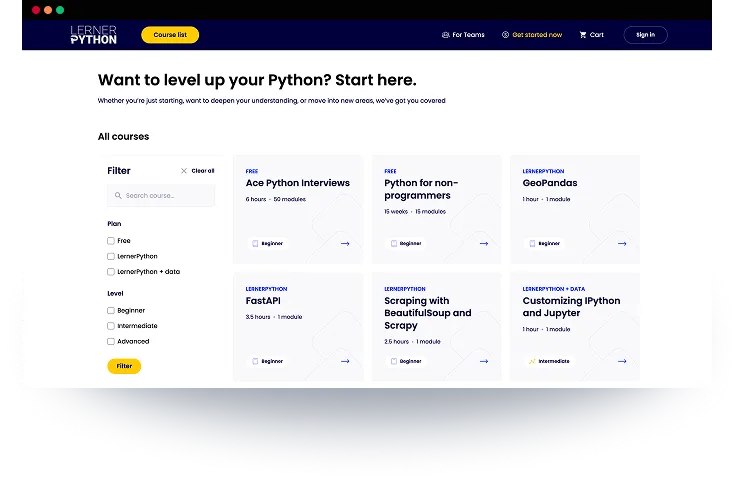
LernerPython is a premium, membership-based e-learning platform created by Reuven Lerner, an internationally recognized teacher and author of books on the Python programming language. The platform offers: structured Python courses, weekly coding challenges, access to a community via Discord, and long-term memberships for programmers at various skill levels.

Enostrada
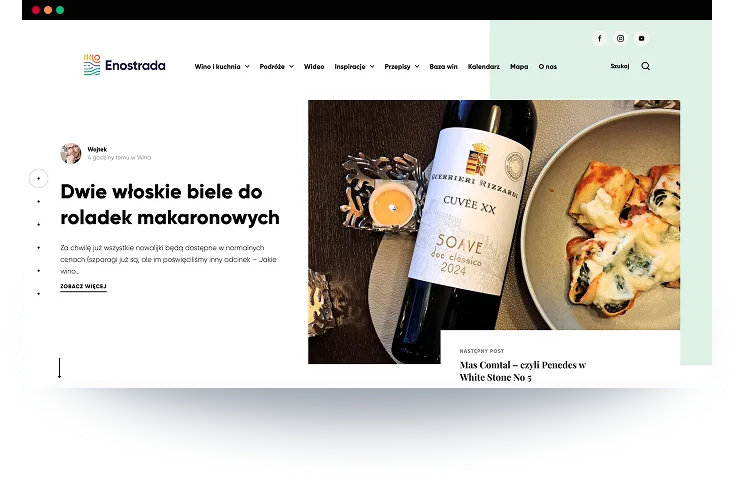
A lifestyle media project created by three enthusiasts: Robert (wine expert), Wojtek (culinary creator) and Kamil (travel & experiences). Their vision: a single modern platform combining wine, food, travel, and events, supported by high-quality articles, reviews, pairings and guides.

SCCG

SCCG Management is a leading consulting firm serving the global gaming industry, working with operators, suppliers, regulators and investors across multiple jurisdictions.
Questions about B2B eCommerce on WooCommerce.
Yes. Migrations from licensed proprietary platforms are a category of work for which we have confirmed experience. The first step is mapping what resides in the source platform (catalog, customers, accounts, orders, integrations, custom logic) against what the new WooCommerce-based platform will support. Order history, customer records, pricing data, and SEO authority are all part of the migration plan. Covered in detail on WordPress migration →.
The pricing engine is part of the platform architecture rather than a plugin added onto the system. Account-based pricing tiers, customer-specific contract pricing, tiered volume pricing, currency per customer, and unit-of-measure rules are configured at the engine level. The discipline lies in modeling the contract structure the commercial team operates with, rather than implementing every theoretical pricing combination.
Yes, with the right architecture. WooCommerce on its own is not the constraint – catalog and order performance at scale is a matter of database design, query patterns, caching strategy, search infrastructure (Algolia or equivalent), and integration patterns with the ERP. Catalogs in the hundreds of thousands of SKUs and order volumes that match large B2B operations are within the operational envelope of properly architected WooCommerce platforms.
Through dedicated APIs designed as part of the architecture, not through marketplace plugins added as an overlay. The pattern is two-way integration where the ERP is the system of record for inventory, pricing, and customer accounts; the CRM is the system of record for sales relationships; the PIM is the system of record for product data. WooCommerce becomes the commerce layer that consumes from and writes back to those systems through interfaces designed for the specific business model.