
Enterprise WordPress for education businesses and training providers.
Course commerce, learning platforms, memberships, and the integrations that connect them to the systems your business actually runs on.
Education businesses sell time, expertise, and outcomes – and the platforms behind them rarely fit standard configurations. We build the WordPress estate that training providers, education groups, and online course creators operate on: course catalogs at scale, LMS integrated with your existing stack, memberships and subscriptions, and integrations with the ERP, CRM, and finance systems already in use across your organization.
WHAT CHANGES
Five areas where the platform stops constraining the business – and begins supporting it.
Find out how educational platforms can support your company’s growth rather than hinder it.
01
Course commerce that handles operational complexity
Course pricing rarely fits a single price tag. Early bird, group discounts, vouchers, B2B invoicing, recurring billing, course schedules as product variants – all of it operates within one platform, built on WordPress and WooCommerce.
The result: the commerce layer keeps pace with how sales actually run, instead of constraining the business to what the platform permits.
02
LMS that connects to your existing stack
The learning experience is where students engage with the content — and it does not need to be confined to a separate vendor environment. We integrate WordPress with LearnDash, LMS plugins, video platforms, and identity providers, so the LMS becomes part of the platform rather than a separate system requiring independent maintenance.
The result: one student journey, one admin panel, one source of truth for course progress and revenue.
03
Memberships and subscriptions for recurring revenue
Subscription-based learning, cohort programs, alumni communities, and tiered access models – built on WordPress with WooCommerce Subscriptions and Memberships, configured for the business rules that carry operational significance.
The result: predictable recurring revenue with a member experience the team can extend without an engineering project for every new tier.
04
Multi-language and multi-region from day one
Education is a market where audience and curriculum often cross borders. We design the platform with multi-language content modeling, regional payment methods, local invoicing rules, and the ability to expand into new markets without rebuilding the system.
The result: entering a new language or country becomes a configuration step, not a new project.
05
Integrations with the systems already in use
ERP, CRM, accounting software, identity providers, attendance systems, certification platforms – none of them will be retired. We integrate WordPress as the primary interface for the business, with two-way data flows to the systems of record.
The result: the platform no longer operates in isolation and becomes the connection point between students, marketing, sales, finance, and operations.

Want to see how we’d handle your education platform?
We’ll walk through a working session on your case – course commerce, LMS integration, memberships, and the systems you’d connect to the platform.
WHO NEEDS THIS
Three patterns we work with most often in the education sector.

Training companies selling open courses
Situation: A growing catalog of open courses with variable schedules, group bookings, B2B invoicing, and a small operations team. The current platform handles the basic sale but reveals its limits in edge cases – schedule variants, invoice integration, multi-language for international students, reporting the operations team can act on.
Solution: A WooCommerce-based course commerce platform configured for the operational complexity of training sales, integrated with your invoicing system (Fakturownia, ERP, or a custom finance stack) and the company data lookups used by your finance team day to day.

Education groups with multiple brands or institutions
Situation: A group operating several brands – schools, training institutes, vocational programs – each with its own website, its own audience, its own enrolment flow. The technology estate has accumulated over years, with different stacks per brand. The internal team delivers, but the architectural perspective is missing.
Solution: A single WordPress foundation supporting the portfolio: shared design system, governed content models, common engineering standards, and integration with the systems the group already operates (Microsoft Dynamics, Salesforce, custom enrolment systems). The brand teams retain their brand. The engineering work is done once, not once per brand.

Online course creators and education brands
Situation: An established course business that has exceeded the capabilities of the SaaS LMS it began with. Recurring revenue depends on a platform that remains outside full client control, customization is limited, payment processing margins are fixed, and the audience expects more than the platform provides.
Solution: A WordPress-based learning platform with WooCommerce Subscriptions and Memberships, LMS integration, video hosting, payment processing on terms you negotiate directly, and the ability to extend the experience as the business develops. Migration from SaaS platforms (Podia, Teachable, Kajabi, and similar) is part of the engagement when relevant.
METHODOLOGY
From business model to a working education platform.
STEP 01
Discovery and business model mapping
We begin by understanding how sales operate in practice: course types, pricing models, enrolment flows, payment terms, the B2B and B2C split, and the integration points with finance, ERP, CRM, and LMS. Architecture follows business reality, not the other way around.
STEP 02
Architecture and content modeling
Course catalog data model, content structure, taxonomy at scale, integration boundaries, and the design system that ties the brand experience to the editorial workflow. Decisions are made before development starts.
STEP 03
Build and integrations
WordPress core, WooCommerce, Subscriptions and Memberships, LMS integration, custom Gutenberg blocks for the editorial team, and the integrations with the systems of record. The same team that designed the architecture builds it.
STEP 04
Migration (where applicable)
For clients moving from SaaS LMS platforms or legacy stacks: content, student records, subscription data, course progress, and SEO authority are preserved. URL structure, redirects, and tracking continuity are part of the work.
STEP 05
Launch and ongoing partnership
After launch, the platform continues to evolve. Ongoing engineering, performance work, security maintenance, and feature development run under the Growth & Care → partnership model. The platform develops alongside the business rather than remaining static after the first release.
WHAT YOU GET
Four functional areas that make up an education platform we build.
- WooCommerce configured for course sales, including schedule variants and B2B flows
- Search at scale (Algolia or equivalent) for large course catalogs
- Custom Gutenberg blocks for course catalog editorial work
- Discount structures (early bird, group, voucher, B2B contract)
- Integration with LearnDash or other LMS solutions of your choice
- Memberships and Subscriptions for recurring revenue
- Video hosting integration (Vimeo, Wistia, or custom)
- Community integration (Discord, Slack, or custom forums)
- Two-way integration with ERP, CRM, and accounting systems
- Invoicing integration (Fakturownia, ERP, custom finance stack)
- Company data lookups (VAT registries, KYC providers)
- Payment processing with the providers you negotiate with
- Polylang or WPML configuration for content translation
- Regional payment methods (Stripe, Przelewy24, local providers)
- Local invoicing and compliance (Omnibus, GDPR, local tax rules)
- Multi-currency where the business operates across borders
After the launch
Education platforms keep evolving – new course types, new markets, new compliance requirements, new payment methods. We stay engaged on the platforms we build through the Growth & Care → partnership model, with ongoing engineering, performance work, and platform evolution.
Migrating from a SaaS LMS or a legacy stack? See WordPress migration → – preserving content, student records, subscriptions, and SEO authority is part of the work.
CASE STUDIES
WordPress in practice.
LernerPython
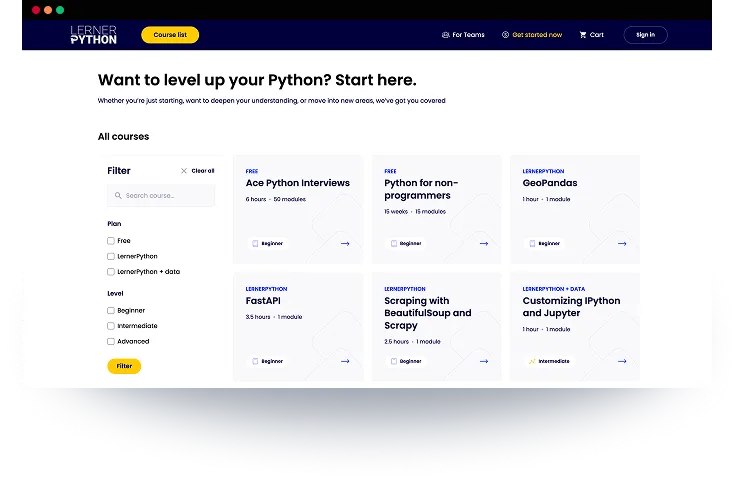
LernerPython is a premium, membership-based e-learning platform created by Reuven Lerner, an internationally recognized teacher and author of books on the Python programming language. The platform offers: structured Python courses, weekly coding challenges, access to a community via Discord, and long-term memberships for programmers at various skill levels.

Enostrada
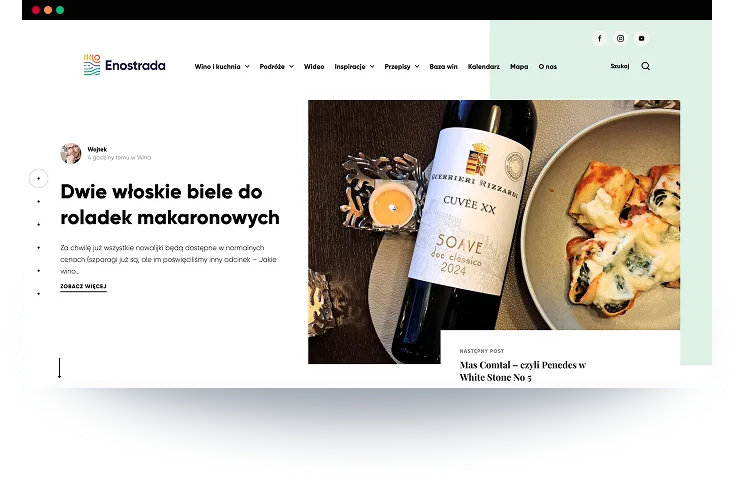
A lifestyle media project created by three enthusiasts: Robert (wine expert), Wojtek (culinary creator) and Kamil (travel & experiences). Their vision: a single modern platform combining wine, food, travel, and events, supported by high-quality articles, reviews, pairings and guides.

SCCG
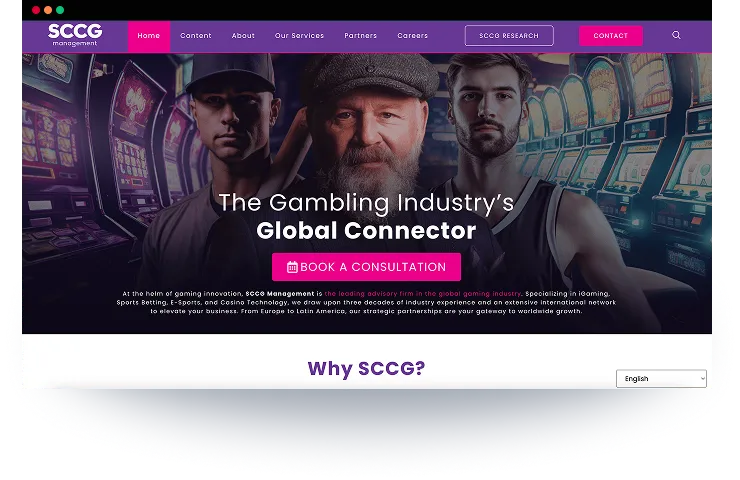
SCCG Management is a leading consulting firm serving the global gaming industry, working with operators, suppliers, regulators and investors across multiple jurisdictions.
Questions about
education platforms.
We integrate. Building an LMS from scratch rarely makes operational sense – established LMS plugins handle the learning experience effectively. The value we bring lies in the integration: connecting the LMS to WooCommerce for commerce, to Memberships for access control, to your CRM for student records, and to the editorial workflow that operates in your organization.
es. Migrations from SaaS LMS platforms are a category of work for which we have confirmed experience. The first step is mapping what resides in the SaaS platform (courses, students, subscriptions, payment history) against what the new WordPress-based platform will support. Content, student records, subscription continuity, and SEO authority are all part of the migration plan. Covered in detail on WordPress migration →.
WooCommerce handles the commerce layer; the complexity is addressed in how it is configured for the specific business. Early bird windows, group pricing, voucher logic, B2B contract pricing, and recurring billing are all routine. The discipline lies in defining which pricing rules carry operational significance for the business and modeling them precisely, rather than implementing every theoretical case.
Both. The technical patterns overlap significantly – course catalogs, enrolment flows, LMS integration, reporting – but the integration points differ. Corporate L&D typically integrates with HRIS and identity systems; commercial training providers integrate with finance, marketing automation, and B2B sales tools. We have confirmed experience across both segments.