
Technology for animal welfare in Japan –
a complete platform migration delivered through Tech To The Rescue
How we partnered with the Animal Rights Center Japan to migrate Hachidory – their vegan and ethical information platform – from a custom legacy CMS to WordPress, preserving years of Japanese-language content, restaurants, recipes and event listings, so the organisation could focus on its mission instead of its technology.

Hachidory is a vegan and ethical lifestyle platform operated by Animal Rights Center Japan (ARCJ) – a Japanese nonprofit dedicated to ending unethical practices.
– like factory farming, raising awareness of animal welfare, and helping animals approach their natural existence. Hachidory itself serves as an information hub for the Japanese vegan community: a catalog of vegan-friendly restaurants, hotels and venues, a recipe library, event listings, books, and editorial content connecting readers back to the broader mission of animal rights.
Website type: Information portal + catalog + recipe library
Type: Full Project Delivery
Timeline: Migration delivered in 2022; platform live and stable since
KEY PROBLEMS BEFORE COLLABORATION
Challenges
Platform locked in a custom legacy CMS. Hachidory was running on a proprietary content management system backed by a PostgreSQL database – meaning the organisation depended on that specific technology stack to publish anything, and had no realistic path to evolve the platform.
Years of content at stake. Restaurants, hotels, places, recipes, books, events – every category had grown organically over years of editorial work. Any migration carried the real risk of losing or corrupting content the team had built piece by piece.
Japanese language as a technical layer, not just a content layer. Hachidory operates entirely in Japanese – meaning the migration had to handle UTF-8 encoding properly across every record, every category, every metadata field, with full preservation of Japanese typography.
An NGO budget meeting an enterprise-grade technical challenge. A platform migration of this scope would normally exceed what an animal-welfare nonprofit could fund – without a different model of engagement, the project simply couldn’t happen.
What we had to solve
- Migrate the entire platform from a custom PostgreSQL-based CMS to WordPress – without losing a single record across years of accumulated content
- Preserve full Japanese-language fidelity through every step of the migration – including category names, post metadata and editorial text
- Rebuild the catalog architecture using WordPress Custom Post Types – restaurants, hotels, places, recipes, books, events – each with their own schema and filtering needs
- Migrate the complete media library and reconnect every image to its corresponding content
- Deliver the new platform under a charity engagement model – making enterprise-grade migration accessible to an organisation that couldn’t otherwise have afforded it
- Hand off a platform the team could run themselves, in their own language, without ongoing developer dependency
“Our mission is animal welfare — not website maintenance. We needed a partner who could move our platform onto something we could actually run ourselves, without losing the years of content we’d built.”
Hachidory
OUR SOLUTION
Our solution for Hachidory
WLC took on Hachidory as a pro-bono engagement through Tech To The Rescue – a global initiative connecting tech companies with NGOs that need technical work they can’t otherwise fund. We rebuilt Hachidory’s catalog architecture on WordPress with full Custom Post Type modelling for each content category, wrote custom migration scripts to convert the PostgreSQL data into WordPress’s native import format, and preserved the full Japanese-language content stack end to end. The platform has been running stably since.
SOLUTION 01
Complete migration from custom PostgreSQL CMS to WordPress
SOLUTION 02
Custom migration scripts purpose-built for the legacy data structure
SOLUTION 03
Full Japanese-language preservation across every record
SOLUTION 04
Custom Post Type architecture for six distinct content categories
SOLUTION 05
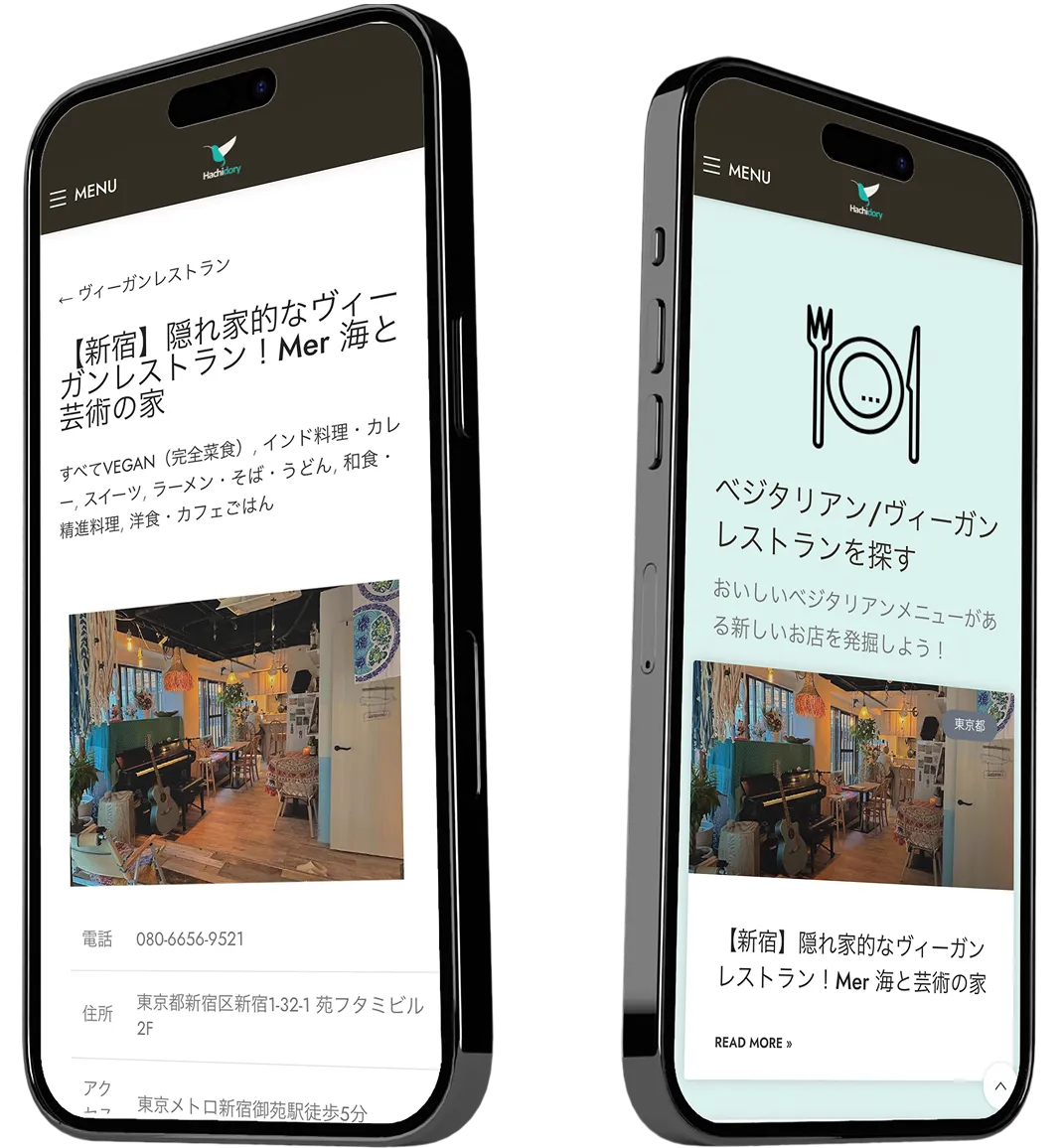
Interactive map of vegan locations across Japan
What we implemented
1. A purpose-built migration pipeline
- The biggest technical challenge of the project: converting data from a custom CMS backed by PostgreSQL into a format WordPress could ingest cleanly. We wrote custom migration scripts that mapped every record, every category and every relationship from the legacy database into WordPress’s native import structure – with manual verification on every step to catch what automation couldn’t.
2. A content architecture designed for the catalog
- WordPress Custom Post Types were structured to mirror how Hachidory’s content actually works: vegan-friendly restaurants, hotels and places, recipes, books and events each became its own content type with its own attributes and filtering logic. The team can now publish into any category without it requiring a developer to extend the schema.
3. Full Japanese-language fidelity
- Every step of the migration was audited against the original content to make sure Japanese typography, encoding and metadata transferred cleanly. With an 11-hour time difference and no possibility of live calls, the team verified content mapping through structured asynchronous communication – including cross-checking record translations to confirm nothing had been corrupted in transit.
4. An interactive map of vegan Japan
- One of the centerpieces of the new platform: a map of vegan-friendly locations across Japan (primarily Tokyo), letting users discover where they can actually eat, stay and engage with the vegan community in their own cities.
5. Recipe library and editorial hub
- A vegan recipe library – including category-specific content like vegan sushi – and a blog hub for ARCJ’s broader editorial mission, all running on the same architecture, all manageable by the team without developer support.
6. A complete media library migration
- Every image attached to every piece of content was migrated alongside the data, with media references properly reconnected – so years of visual editorial work didn’t have to be rebuilt from scratch.

Let’s talk about how we can apply similar solutions to your project.
EFFECTS
Results (Before → After)
WordPress – open, maintainable, owned by the organisation
Custom CMS with proprietary PostgreSQL backend
Standard WordPress architecture – portable, exportable, extendable
Locked into a single proprietary system
Custom Post Types for restaurants, hotels, places, recipes, books, events
Custom CMS-specific structure
Fully migrated with end-to-end UTF-8 fidelity – no data loss across records or metadata
Preserved within the legacy system
Migrated in full and reconnected to corresponding content
Bound to the legacy CMS
Team publishes, edits and manages the platform independently
Dependent on the original CMS provider
Delivered pro bono through Tech To The Rescue
Out of reach for a nonprofit budget
Stable in production since 2022
–
“What we appreciated most is that after the migration, we could finally focus on our mission again – not on the technology underneath it.”
Hachidory
Why it worked
- Pro bono done seriously – the engagement was charity in commercial terms, but enterprise-grade in technical execution
- Migration treated as a process, not a script – manual review on every record, zero content loss across years of accumulated editorial work
- Japanese-language fidelity audited end to end – language wasn’t a content layer, it was a technical requirement, and was handled accordingly
- Built for handover from day one – the goal wasn’t a successful launch, it was an NGO operating its own platform years later. It does.
- Partnership through Tech To The Rescue – making serious engineering accessible to organisations whose work matters more than their budget
“The platform has been running stably under our care for years now. That’s the best testament we can give – we still use what they built, and it still serves our community.”
Hachidory